Germany is on course to abolish a fast-track path to German citizenship that requires C1 level language skills and exceptional integration. We spoke to a foreign resident in Berlin who raced to improve her German to apply before it’s too late.
When Rachel, a software engineer and musician from the United States, arrived in Berlin in May 2022, she had no idea she’d have the opportunity to become German just over three years later.
But thanks to the fast-track citizenship path, that has allowed some highly-qualified foreign residents to naturalise after three years, the 33-year-old will soon receive her German passport.
However, she may be one of the last to have this opportunity, for which you need C1 level German and proof of exceptional integration.
That’s because the German government is set to axe this route – which has been dubbed ‘turbo-naturalisation’ by right-wing politicians.
It’s still unclear exactly when the three-year-track to naturalisation will be scrapped, and whether there will be a transition period. But it’s expected to move forward when parliament is back in session from September 8th.
The move has prompted some foreign residents – like Rachel – to apply before it’s too late.
READ ALSO: Germany moves forward with law to end fast-track citizenship process
Advertisement
‘Learning the language was a priority’
Not many foreigners have opted for for the faster-track option since its introduction in 2024. One of the main reasons is because passing a C1 German language test is no easy task, especially in a short amount of time.
But Rachel, who had previously been living in other parts of Europe, was keen to become fluent in German from the moment she came to Berlin. Initially, she had aimed to apply for permanent residency.
“Already when I arrived, I was studying a lot of German for that [permanent residence], and also because I wanted to be able to integrate and be a part of society. And if I wanted to eventually be able to vote, I wanted to be able to read the newspapers and understand what’s going on,” she said. “It’s hard to really understand a culture if you can’t speak its language. So learning the language was a priority for me even then.”
A German dictionary stands on a shelf. How do you feel about learning the language? Photo: picture alliance / dpa | Oliver Berg
Germany’s previous coalition government reformed citizenship laws in June 2024. Under the changes, dual citizenship is allowed and foreign residents can apply to naturalise after five years of residence instead of the previous eight. Plus the three-year naturalisation route was added.
READ ALSO: What do I need to apply for German citizenship under the new law?
After the new law came into force, Rachel set her sights on securing that all-important C1 German language certificate so she could pursue the fast-track route.
“I went into sort of ‘turbo German’ studying mode where it became like my only hobby,” she said. “I was taking classes, working with tutors, and not only language classes – I also signed up for art and theatre classes at the Volkshochschule, and did volunteering out in Schwarzwald. I tried to get as many opportunities to learn as possible.”
While Rachel admitted it could get frustrating at times because “German is not the easiest language”, she said overall the experience was “exciting”, adding: “I’ve always liked learning.”
Three to six hours of German per day
However, earlier this year, news emerged that the incoming coalition planned to ditch the three-year path to naturalisation. Rachel stepped her studies up, even though the timeline for the law change wasn’t clear. She hoped to pass her C1 German exam before her three-year Berlin anniversary on May 25th this year.
“But then I realised that was too ambitious, it was going to be too hard,” she said.
Still, Rachel kept going and even reduced her hours at work to take on a German literature for language learners class.
After it became clear the new coalition government was progressing fast to ditch the three-year citizenship path, Rachel moved her exam date closer.
Advertisement
“And I started studying anywhere between three and six hours a day,” she said. “I dropped all my other hobbies and was just studying German all the time.”
After doing some research, and given the uncertainty of the situation, Rachel decided to take her chances and apply for German citizenship at the end of May, even though she didn’t yet have her C1 level test results. Instead, she contacted a former German teacher who wrote a note confirming she was fluent in German.
“I just wanted it to be a placeholder to say, ‘I don’t have my result yet, but look, just wait a couple of weeks and I’ll have it.'” she said.
READ ALSO: When does Germany consider a foreigner to be successfully integrated?
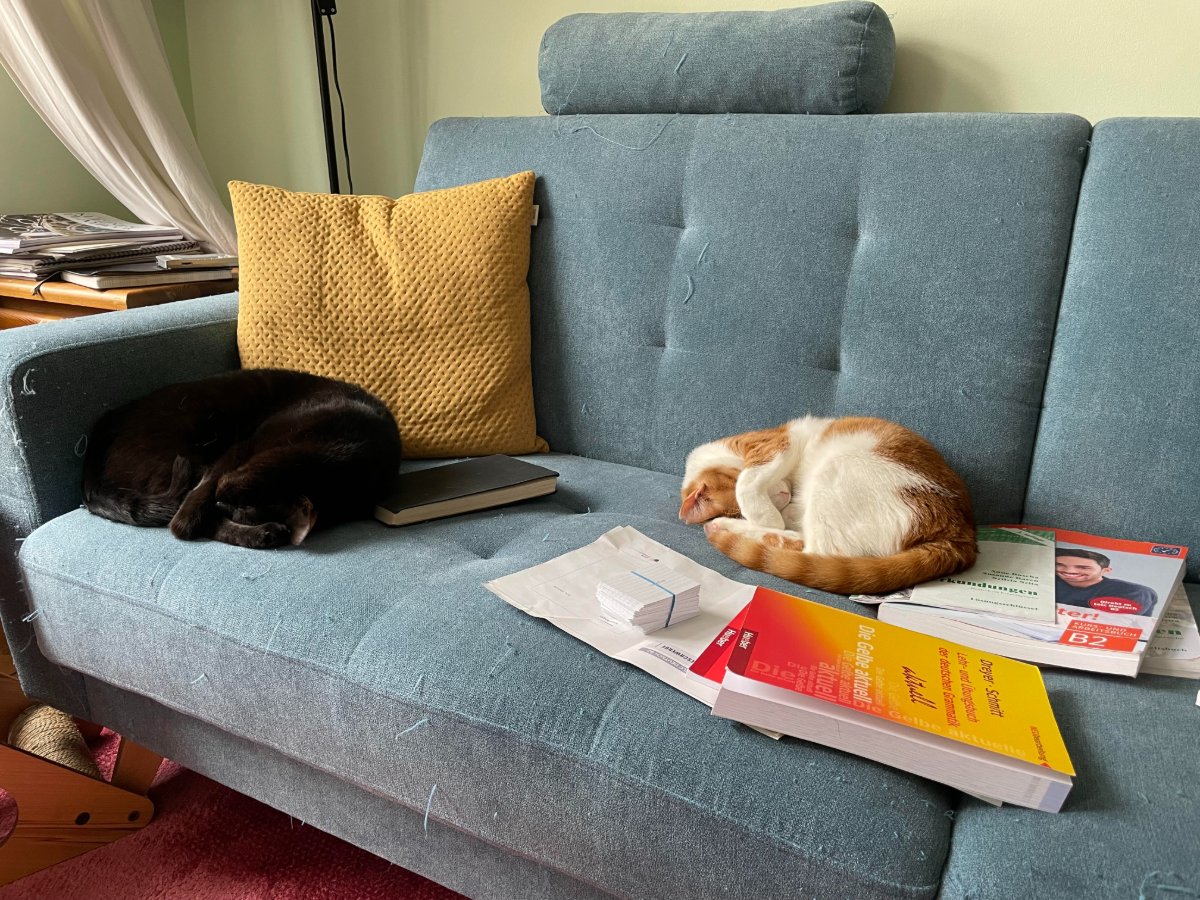
Rachel’s cats with her German study materials. (Photo courtesy of Rachel)
Following another hiccup – when the Berlin naturalisation website went down for a few days – Rachel was finally able to apply on May 30th.
Advertisement
“I just cancelled my plans and spent the whole evening putting my application together and submitting,” said Rachel.
On June 6th, Rachel sat her C1 level exam. Initially, she feared she might not clear the hurdle.
“To my surprise, I did end up passing,” she said. “But I didn’t get the results for about another five weeks after that.”
Rachel was finally able to submit the certificate as an additional document to her application.
About a week after, she got an email from the LEA (immigration office) in Berlin saying staff were processing her application and needed some updated documents.
In the end, it appears Rachel’s hard work has paid off – earlier in August, she received an appointment from the LEA for German naturalisation. She is on course to become German before the law change.
Rachel said she has “huge appreciation” for the immigration office for processing her application so quickly.
READ ALSO: How many applications for German citizenship are still pending?
Advertisement
What people get wrong about fast-track citizenship
Getting citizenship is one of the most exciting milestones in a foreign resident’s life. But the routes to becoming German can be controversial in Germany, especially among centre-right and far-right circles.
Before the snap election in February, Christian Democrat (CDU) leader Friedrich Merz, who went onto become Chancellor, threatened to reverse all the citizenship reforms.
However, Merz failed to gather support for this within the coalition government. The decision to only get rid of the three-year citizenship path is therefore a compromise between the governing conservatives and the centre-left Social Democrats.
Proponents for the fast-track path say that the small number of foreigners who manage to become fluent in Germany and integrate themselves fully in just three years of residence deserve to be recognised for that achievement.
The vast majority of foreign residents in Germany gain citizenship under the standard five-year track. Up to June 30th 2025, only 573 people got German citizenship in Berlin after three years of residence – accounting for just over one percent of all naturalisations.
Rachel said she can understand why some people are concerned about the fast timeline to naturalisation. But added: “I think a lot of people don’t realise how hard this is and how few people have qualified.
“And the fact that if you qualify, it means you really want it and you’ve worked really hard.”
READ ALSO: ‘Slap in the face’ – Applicants blast Germany’s plan to scrap citizenship reform