Europe pulled off something no empire, alliance, or union had ever done before: it erased its borders by choice. The Schengen experiment isn’t just a travel perk – it’s a political revolution hiding in plain sight.
The Revolutionary Nature of Schengen
The Schengen framework delivers real, tangible advantages for citizens, businesses and public authorities across Europe. The benefits are substantial – and pretty varied. But to understand their true significance, we need to grasp what Schengen represents in the broader context of international law and European integration.
No other region in human history has voluntarily dismantled internal borders to this extent. The Romans had their empire, sure, but that was imposed through conquest. The United States has free movement between states – but they share a single government. Schengen? It’s 29 sovereign nations choosing to trust each other with their borders. That’s unprecedented.
The Visible Benefits: Freedom of Movement
Ease of travel is the obvious one. Citizens, residents, visa-holders… they can all cross internal borders without checks. No more queuing for hours at border posts. Tourism becomes simpler. Business travel too. You can literally drive from Portugal to Poland without showing your passport once. That’s remarkable when you think about it.
But let’s dig deeper. The Court of Justice has consistently held that free movement represents a fundamental right, not merely a convenience. In cases like Wijsenbeek (C-378/97) and Melki and Abdeli (C-188/10 and C-189/10), the Court emphasized that any restriction must be strictly necessary and proportionate. This isn’t just policy – it’s quasi-constitutional law at this point.
The psychological impact? Immeasurable. Citizens in border regions develop what researchers call “transnational habitus” – they think and act European rather than national. Kids in Strasbourg grow up with friends in Kehl. Workers in Lille pop over to Belgium for lunch. This wasn’t possible when our parents were young. Now it’s normal.
Economic Dimensions: Beyond the Obvious
Then there’s economic growth. The removal of border controls has enhanced trade flows significantly. Tourism too. Goods and services circulate more efficiently when trucks don’t have to stop every few hundred kilometers for document checks. A Spanish company can deliver to Germany as easily as they deliver domestically. Well, almost as easily.
The European Union’s economy reached $19.99 trillion (nominal) in 2025, representing approximately one-sixth of the global economy. A 2016 study by the Centre for Economic Policy Research found that complete Schengen collapse would reduce EU GDP by 0.31%. Applied to today’s economy, that translates to roughly $62 billion annually – a staggering cost that underscores just how economically vital the border-free zone has become. And that’s conservative. It doesn’t capture the dynamic effects: companies that exist only because of Schengen, supply chains that became viable, innovations that emerged from cross-border collaboration.
Think of Zalando, the German e-commerce giant. They deliver to Belgium and Germany within 24 hours – same as domestic. Their entire business model depends on borderless logistics. Pre-Schengen? Impossible.
Small businesses probably benefit the most, proportionally speaking. A craftsperson in Slovenia can now sell at markets across Austria, Italy, and Croatia without the bureaucratic nightmare that existed before. Food trucks follow festivals across borders. Plumbers in border regions service clients in 2-3 countries. These aren’t multinational corporations with teams of lawyers – they’re regular people whose livelihoods have been transformed.
The Labour Market Revolution
The employment dimension is huge. Citizens of participating states can work across borders much more easily now. Got a job offer in Amsterdam but you live in Brussels? No problem – just commute. Seasonal workers can follow harvests from Spain to Germany to Poland. And if you have a valid residence permit in one country, moving around the rest becomes much simpler. Labour market flexibility has increased dramatically.
But here’s what the statistics miss: labour market integration isn’t just about numbers. It’s about matching skills to needs across an entire continent. The German engineering firm that finds the perfect specialist in Prague. The Italian restaurant in Stockholm that can hire actual Italian chefs. The French hospital that recruits Spanish nurses during shortages.
Professor Alberto Alemanno at HEC Paris calls this “the invisible hand of Schengen” – market forces operating at a continental scale, allocating human resources where they’re most productive. Classical economists would weep with joy.
Cultural and Social Integration
Cultural exchange – this one’s harder to quantify but it’s real. Increased mobility means people actually meet their European neighbors. Students do Erasmus programs without worrying about border hassles. Families spread across three or four countries can stay connected. It fosters mutual understanding and, arguably, some kind of shared European identity. Though how much is debatable.
The Erasmus generation – over 16.7 million participants since 1987 according to the European Commission’s latest data – couldn’t have happened without Schengen. These aren’t tourists; they’re living, studying, falling in love across borders. The famous “one million Erasmus babies” figure from the 2014 EU Impact Study captures something profound: a generation of genuinely European citizens born from cross-border relationships.

Jurgen Habermas, the German philosopher, argues that Schengen enables what he calls “constitutional patriotism” – loyalty to shared values rather than ethnic identity. You see it in the protests when governments threaten to reintroduce borders. Young Europeans don’t just tolerate free movement; they consider it a birthright.
Emergency Response and Crisis Management
There’s also emergency response which people don’t think about until they need it. No internal border checks means ambulances can rush patients to the nearest hospital, even if it’s across a border. Firefighters can respond to forest fires without paperwork delays. During floods or other disasters, help arrives faster. Coordination is just easier when you’re not dealing with border bureaucracy.
The 2021 floods in Germany and Belgium proved this. Belgian rescue teams were operating near Aachen within hours. Dutch helicopters evacuated German citizens. Luxembourg hospitals treated patients from all three neighbors. The EU Civil Protection Mechanism enabled seamless cross-border hospital cooperation through the Euregio-Meuse-Rhine framework. No paperwork, no delays, just help arriving when needed. Try explaining that to someone from the 1980s.
The COVID Test: What We Almost Lost
Want proof of Schengen’s value? Look at what happened during COVID-19. When EU reintroduced temporary internal border controls in March 2020, the costs were staggering. Supply chains broke down. Commuters couldn’t get to work. Tourism collapsed entirely in some regions. Fresh produce rotted in trucks stuck at borders that hadn’t existed for decades.
The European Commission documented massive disruptions. During the worst period, logistics companies reported delays of 40+ hours at some borders. Pharmaceutical companies couldn’t get medicines to hospitals efficiently. Even essential workers – doctors, nurses – struggled to cross borders to their workplaces.
But here’s what really matters: the political reaction. The reintroduction of borders wasn’t coordinated. It was panic – pure national reflex. Italy closed first, then Austria, then everyone else in a cascade of unilateral decisions. The Commission was helpless. Years of integration unraveled in a few hours.
Yet the system survived. Why? Because the costs of closure were immediately obvious. Industries screamed. Regions rebelled. Citizens demanded their freedoms back. By May 2020, governments were desperately seeking ways to reopen. The “temporary” measures that skeptics predicted would become permanent? They couldn’t last a few months.
The Intangible Benefits
But it’s not just about economics. There’s something fundamentally different about living in a borderless Europe. Weekend trips to neighboring countries become spontaneous. “Let’s drive to that restaurant in Belgium” is a normal Saturday plan when you live in Maastricht. Kids grow up thinking it’s normal to have friends from four different countries. That psychological shift – from “foreign” to “just next door” – might be Schengen’s most profound impact.
As a friend of mine from Germany once said: “Schengen didn’t just remove borders; it removed them from our minds.” The mental maps of young Europeans don’t have the thick black lines our parents drew. They see a continuum, not a patchwork.
Measuring the Unmeasurable
Of course, measuring some of these benefits precisely is tricky. How do you quantify “cultural exchange”? What’s the monetary value of being able to visit your grandmother in another country without border hassles? The European Commission tries with their impact assessments and economic models. But some benefits just can’t be captured in spreadsheets.
The methodological challenges are real. Traditional economic models assume closed systems. Schengen creates an open one. How do you measure the value of options never exercised? The job not taken because you could take it? The business not started because you could start it? The threat that doesn’t materialize because criminals know police cooperate?
The Security Dividend
And then there are the unexpected benefits. Cross-border hospital cooperation means specialized treatments are more accessible. Police can pursue criminals across borders more effectively (though that’s a double-edged sword depending on your perspective). Even things like cross-border public transport have become viable – trains and buses that simply wouldn’t have made economic sense with border controls.
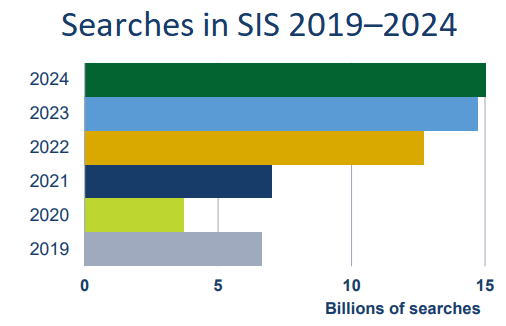
In 2024, authorities connected to the system recorded 15,044,676,229 access instances. That’s over fifteen billion searches. Not million – billion.
Want some context? Back in 2021, member states ran about 7 billion searches through the system. By 2022, that jumped to 12.7 billion (an 81% increase from the previous year). And now we’re at fifteen billion. Every few seconds – literally every few seconds – somewhere in Europe, someone’s checking if a person’s wanted, if a vehicle’s stolen, or if documents are legitimate.
Ireland shows exactly why this matters. Despite not being in the border-free zone, they joined SIS II in early 2021 to strengthen their security. In just nine months, Irish police arrested 162 people flagged in the system – individuals wanted for everything from sexual assault to drug trafficking to burglary across Europe. These weren’t local criminals; they were people who’d committed crimes elsewhere in Europe and thought they could disappear in Dublin or Cork. Before SIS II? They probably could have. Now? The Garda can instantly check if that person at a routine traffic stop is wanted in Rome or Warsaw.
It’s become the backbone of European security cooperation, though most people have no idea it even exists. Ireland’s not even fully in Schengen, yet they’re catching over 18 criminals a month through the system. Imagine the impact across all 29 countries.
In March 2023, a renewed version of the system (referred to as “SIS-Recast”) became operational, replacing SIS II and introducing enhanced capabilities for law enforcement and border management. It’s the most consulted database in Europe. Critics focus on surveillance concerns (valid ones), but the operational benefits are undeniable. Ireland’s Garda notes the system enables real-time alerts across the entire Schengen zone for wanted persons, missing children, and stolen property.
Alphanumeric searches performed in 2024, breakdown per Member State/JHA Agency
| Member State / Entity | Alphanumeric searches – manual processes | Alphanumeric searches – automated processes | Total alphanumeric searches |
|---|---|---|---|
| AT | 233,617,057 | ||
| BE | 53,389,294 | 2,935,980,638 | 2,989,369,932 |
| BG | 2,555,424 | 197,469,798 | 200,025,222 |
| HR | 365,305,261 | 237,484,043 | 602,789,304 |
| CY | 44,061,894 | 0 | 44,061,894 |
| CZ | 92,222,667 | 136,835,952 | 229,058,619 |
| DK | 47,558,269 | ||
| EE | 70,976,375 | ||
| FI | 30,242,417 | 39,413,027 | 69,655,444 |
| FR | 334,913,195 | 1,071,581,357 | 1,406,494,552 |
| DE | 765,100,274 | ||
| EL | 102,373,509 | 20,760,505 | 123,134,014 |
| HU | 89,573 | 133,539,059 | 133,628,632 |
| IS | 39,557 | 55,501,545 | 55,541,102 |
| IE | 15,475,999 | 4,805,533 | 20,281,532 |
| IT | 367,292,649 | 343,460,689 | 710,753,338 |
| LV | 46,797,926 | ||
| LI | 247,249 | 551,457 | 798,706 |
| LT | 34,015,064 | 0 | 34,015,064 |
| LU | 8,817,179 | 13,087,313 | 21,904,492 |
| MT | 14,471,112 | 98,566,746 | 113,037,858 |
| NL | 260,953,234 | 3,919,309,565 | 4,180,262,799 |
| NO | 68,137,072 | 7,812,832 | 75,949,904 |
| PL | 571,005,765 | ||
| PT | 116,701,441 | 0 | 116,701,441 |
| RO | 445,054,394 | ||
| SK | 35,821,715 | 20,547,811 | 56,369,526 |
| SI | 53,593,561 | 0 | 53,593,561 |
| ES | 571,139,225 | 698,059,052 | 1,269,198,277 |
| SE | 75,683,941 | ||
| CH | 251,332,378 | ||
| Total MS | 3,312,904,192 | 9,934,766,922 | 15,013,751,592 |
| Eurojust | |||
| Europol | 476,883 | ||
| Frontex | 679 | ||
| TOTAL | 3,313,381,754 | 9,934,766,922 | 15,014,229,154 |
Constitutional and Legal Innovations
What’s rarely discussed: Schengen forced legal innovation. The principle of mutual recognition, now fundamental to EU law, emerged from Schengen necessity. If a Portuguese visa is valid in Poland, why not a Portuguese law degree? Or a Portuguese product standard? Schengen became the laboratory for broader integration.
The European Arrest Warrant, the European Investigation Order, the European Public Prosecutor’s Office – all build on Schengen’s foundation. We’re witnessing the emergence of a European legal space, not through grand constitutional moments but through practical cooperation. Schengen is quietly building European federalism from the bottom up.
The Geopolitical Dimension
Schengen also projects soft power. When Ukraine’s protesters waved EU flags in 2014, they weren’t dreaming of agricultural subsidies. They wanted what Schengen represents: inclusion in a space of freedom and prosperity. The agreement has become a symbol of what Europe can achieve when it transcends nationalism.
Conversely, Brexit negotiations revealed Schengen’s strategic value. The UK’s insistence on ending free movement came with costs they hadn’t anticipated. Northern Ireland’s border became unsolvable precisely because people had forgotten what borders mean. Schengen’s absence defined the negotiations as much as its presence defines the continent.
Challenges and Adaptations
The system isn’t perfect, obviously. The 2015 migration crisis exposed weaknesses in external border management. The COVID-19 pandemic showed how quickly national reflexes resurface. Terrorism, organized crime, and now hybrid threats from hostile states – all test Schengen’s resilience.
But here’s the key insight: Schengen keeps adapting. After 2015, we got the European Border and Coast Guard Agency with real operational capacity. After COVID, they’re developing health protocols that preserve free movement during pandemics. After Russia’s aggression, they’re strengthening external borders while keeping internal ones open.
This adaptability isn’t weakness – it’s evolutionary strength. Rigid systems break. Flexible ones survive. Schengen bends but doesn’t break because it serves real human needs, not abstract principles.
The Democratic Paradox
There’s a paradox here worth exploring. Schengen is profoundly democratizing – it gives ordinary citizens freedoms previously reserved for elites. Yet it emerged from intergovernmental negotiations, not popular movements. The people didn’t demand Schengen; they discovered they loved it after it existed.
This challenges our assumptions about European integration. Maybe citizens don’t need to understand every technical detail. Maybe they just need to experience the benefits.
Schengen suggests that Europe is built not through referendums but through creating realities people can’t imagine living without.
Future Trajectories
Where does Schengen go from here? The obvious answer: eastward. The Western Balkans are knocking. Ukraine has applied for EU membership. Eventually, geography and economics will prevail. Europe’s natural borders are the Atlantic, Mediterranean, and (controversially) something in the East.
But the deeper question: can the Schengen model be replicated? ASEAN is watching. The African Union has similar ambitions. Mercosur made attempts. None have succeeded like Schengen. Why? Because Schengen required not just removing borders but building trust, sharing sovereignty, and accepting that your neighbor’s problem is your problem.
That’s the real revolution. Not the absence of border posts but the presence of solidarity. When Portugal had financial crisis, Schengen continued. When Greece nearly left the euro, Schengen survived. The agreement has outlasted recessions, terrorist attacks, migration crises, and a pandemic. It’s proven more durable than many predicted.
Conclusion: The Irreversible Experiment
Even critics of the EU generally acknowledge that Schengen, whatever its flaws, has made life easier for millions of Europeans. And after experiencing what border controls meant during 2020, most people have a new appreciation for what we almost lost.
But appreciation understates it. Schengen has become constitutive of European identity. You can imagine the EU without the euro (some countries don’t use it). You can imagine it without the Commission (though it would be different). But can you imagine it with hard borders between France and Germany? Between Austria and Italy? The question answers itself.
We’ve crossed a threshold. Some changes are irreversible not because they can’t be undone legally but because they can’t be undone psychologically. Schengen is one of them. It has created a generation that considers free movement not a privilege but a right, not a policy but a principle, not an experiment but existence itself.
As Jean Monnet wrote in his 1976 memoirs (Mémoires): “Europe will be forged in crises, and will be the sum of the solutions adopted for those crises.” Schengen has been tested by every crisis imaginable. It’s still here. That’s not just policy success; it’s proof that some ideas, once realized, become undeniable.
The American legal scholar Joseph Weiler once asked: “What is Europe’s constitutional moment?” Perhaps it wasn’t Maastricht or Lisbon. Perhaps it was that morning on March 26, 1995, when the first car drove from Germany to France without stopping. No fanfare, no ceremony, just ordinary people discovering they could go where they pleased.
That’s Schengen’s genius. It made the extraordinary ordinary. And once something becomes ordinary, it becomes essential. Try taking it away, and you’ll discover what Europeans really care about.
Of course, this extraordinary achievement didn’t happen overnight – and it still doesn’t. Despite what many believe, joining this border-free paradise isn’t simple.
Myth: Any European country can join Schengen at will.
Fact: Accession requires strict compliance with EU criteria on border management, visa issuance, data protection, and police cooperation. States undergo a rigorous evaluation and must be unanimously approved by existing members before internal border checks are lifted. The process typically takes 5-10 years minimum, as Bulgaria and Romania’s 18-year journey demonstrates.
The complexity of joining Schengen, paradoxically, is what makes it work. Every new member has proven they can be trusted with everyone else’s security. That mutual trust – built slowly, verified thoroughly – is what allows millions to cross borders without showing a passport.
It’s not just free movement; it’s earned freedom.
- This article was written by Besart Bajrami, founder of SchengenVisaInfo.com. Since establishing the platform in 2013, he has been providing reliable information on Schengen visas, travel policies, and the latest EU visa regulations.