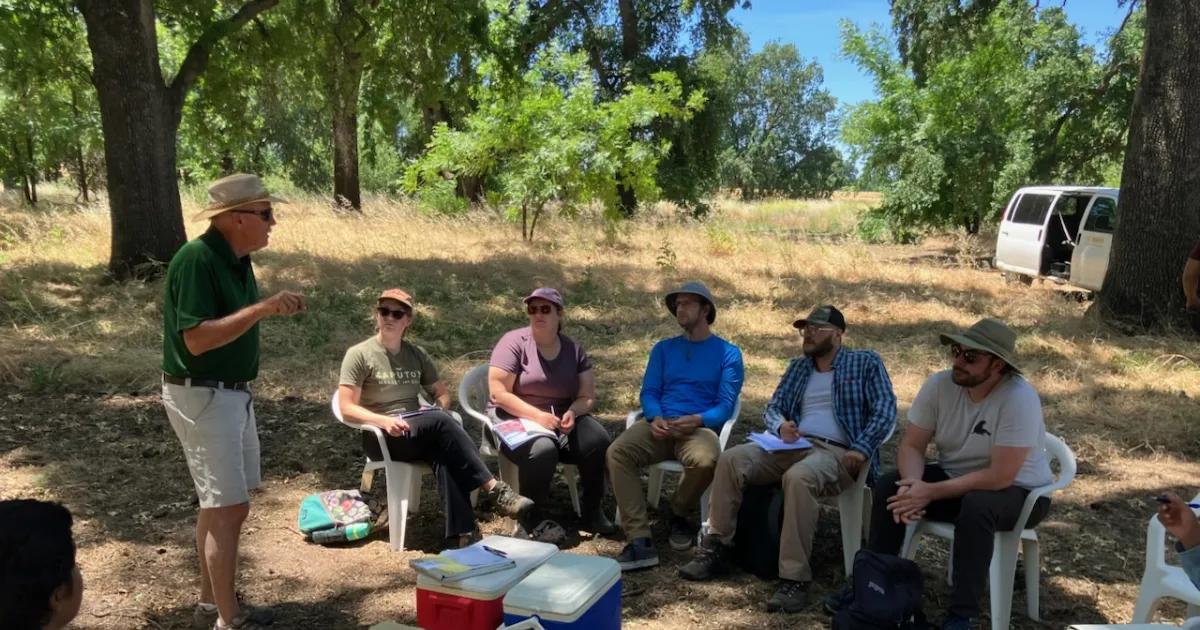
A group of students working with the nonprofit From Farms to Incubators.is sharing the news about the AI system. Amy Wu, founder and chief content director, developed a program to teach students how to effectively communicate agriculture technology.
Starting last September, the students learned digital storytelling, communicating science and documenting the work of AI.
“We also have a guest speaker series where they have been able to connect with rock stars in ag tech,” Wu said.
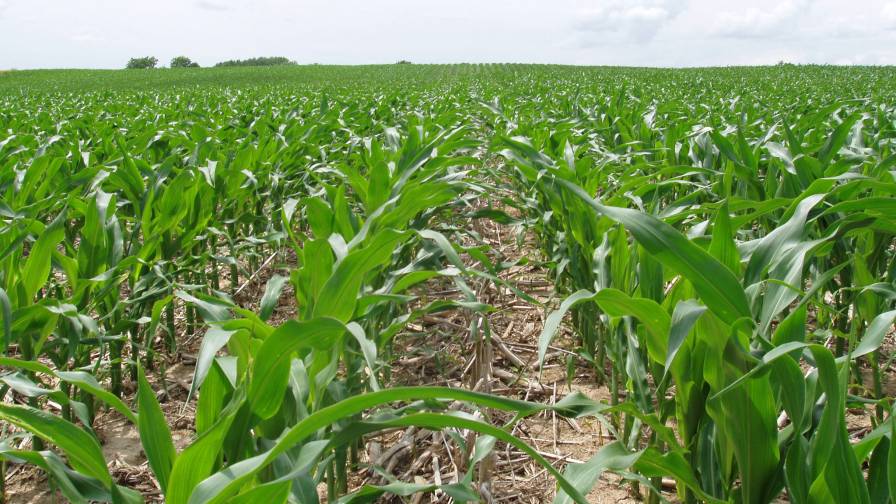
Wu came to UC Merced and met with the professors, then went to the farm at the Kearney Agricultural Research and Extension Center, operated by UC ANR in Parlier, to see the system and document the work.
“We created a menteeship program where students are learning about journalism and communications and also ag tech,” Wu said. “We trained them on interviewing and writing, to document the journey of the AI-generated crop irrigation system.”
They created a package of stories, photos and videos aimed at a broad audience from consumers interested in innovation to farmers seeking help tackling climate change.
Two of the students were undergraduates from UC Merced and a third was a recent graduate from California State University, Monterey Bay. All brought their own experiences and technical knowledge to the project. They developed new skills in writing and editing and connected with speakers representing women in agricultural technology.
Anvi Kudaraya, a UC Merced computer science and engineering undergraduate student from Pleasanton, said she learned the system architecture to get a deeper understanding of the sensors in the field, the AI irrigation model and data visualization. She wrote Python scripts to process real sensor data, which she said taught her “how to handle messy, real-world datasets and prepare them for machine learning models.”
Beyond the technical side, Kudayara said, she learned the value of collaboration and communication in research.
“I learned how important it is to connect technology to a broader purpose, especially when the work can impact something as essential as water use in agriculture.”
She said the project pushed her to step into areas outside her comfort zone, writing and revising the project article for publication and visiting the farm to document the work through photos.
“I came away with a stronger appreciation for how AI in agriculture is not only a technical challenge, but also a human one, requiring communication, community engagement and clear storytelling to make the technology meaningful and scalable.”
For a pilot program, Wu said, “I thought it went very, very well. We went into this not knowing what to expect, but we wanted to expose young people to the possibilities of communicating food and farming.”
Savio Jabbo, a computer science and engineering major from San Diego, said being able to see the cutting-edge research and experience the real world applications is amazing to say the least.
“Usually the work that goes into these projects goes unnoticed,” Jabbo said. “But when you see the impact that it has even on such a small scale, it feels like the whole world should know about it.”
This article was first published on the UC Merced News site.