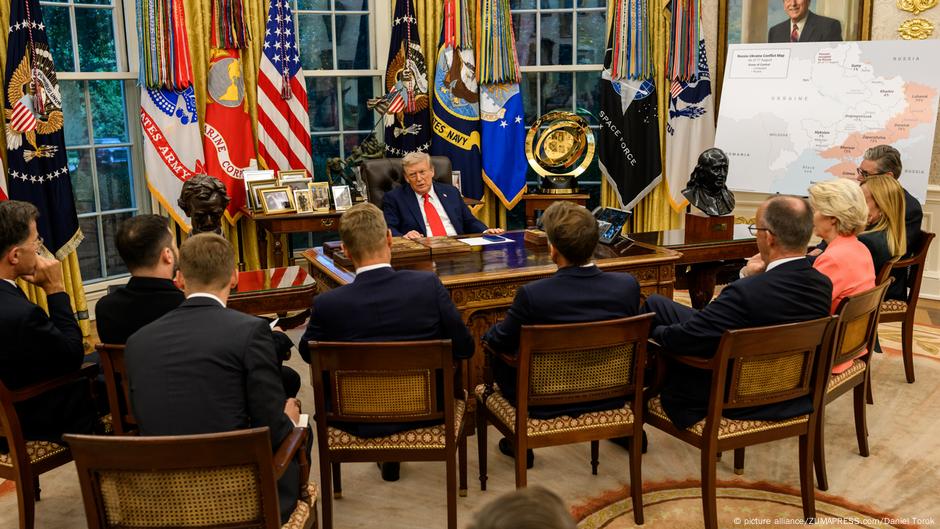
On Tuesday NATO chief Mark Rutte said European allies “were closely coordinating with the Americans,” and were in constant touch with US Secretary of State Marco Rubio, even though the latter has decided to skip a meeting of NATO’s foreign ministers on Wednesday.
US President Donald Trump’s 28-point plan to end Moscow’s war in Ukraine has widely been seen as a Russian wishlist, and one that called for major concessions from Kyiv. But Rutte said that negotiations have to start somewhere.
Experts say Europeans have adopted a “yes, but” approach with the US to keep Trump onside. But there are concerns whether Europeans will manage to sway the outcome of the talks to the extent they want.
“In the past, Europeans have managed to be heard in Washington, but there is no guarantee they will manage to rein in Trump,” Rafael Loss, a policy fellow at the European Council on Foreign Relations (ECFR), told DW.
Europe’s red lines
The original Trump proposal called on Ukraine to concede not just territory currently occupied by Russia, but also to give up parts of the Donbas fortified by Ukrainian armed forces at a huge cost.
It demanded that Ukrainians capped the strength of their armed forces at 600,000 and called for a permanent ban on the country joining NATO.
Ruben Brekelmans, defense minister of the Netherlands, told reporters that Ukraine’s territorial integrity and a strong Ukrainian army were areas Europe wasn’t willing to negotiate on.
A powerful Ukrainian military, “is a strong deterrent towards Russia and makes the entire European security system stronger,” Brekelmans said before heading into a meeting with his European counterparts in Brussels on Monday.
Experts say Trump’s proposal blew through a series of European red lines, including demands that insinuated a rollback of American assets.
“To agree that European fighter jets will be stationed in Poland,” as stated in Trump’s original draft, “suggests that American ones— deployed under this or future US administrations — cannot be there,” wrote Jana Kobzova, co-director, of the European Security Program at the European Council on Foreign Relations (ECFR).
Other clauses appeared to back “Moscow’s demands to move NATO infrastructure as far away from its own western borders as possible, effectively eliminating the alliance’s deterrence on its eastern flank,” Kobzova wrote. “All this would create dangerous precedents affecting the whole of Europe.”
In a counter proposal, Germany, France and the United Kingdom suggested a cap on the Ukrainian army at 800,000 soldiers in peacetime, highlighted that NATO membership was contigent on a consensus among NATO members, and said NATO fighter jets, including American ones, would be stationed in Poland.
But is Europe being heard?
Europeans were caught unawares when Trump’s proposal first leaked. They had not been consulted by their key ally across the Atlantic in advance.
Then European security advisers met Secretary of State Rubio in Geneva and floated the counter proposal.
But just as it seemed like the Europeans were finding a seat at the table, they were once again sidelined as the US invited only a Ukrainian delegation to Miami for talks.
At the start of Monday’s defense ministers meeting, Kaja Kallas, the EU’s top diplomat, told reporters that Ukrainians had been alone in the talks on Sunday, and that their position had been stronger “if they would be together with Europeans.”
Others say Europe must at least partly share the blame for losing influence in driving the outcome.
“Europe doesn’t have a [Ukraine] strategy, so it is forced to react. Trump is in the driver’s seats and sometimes he can be reasoned with, sometimes not,” said Loss. “Fundamentally, Europeans have not answered the question of what they want to achieve” in Ukraine when the war comes to an end.
What security guarantees is Europe seeking for Ukraine?
The “coalition of the willing” — a grouping of 31 mostly European countries led by France and the UK — have expedited work on security guarantees for Ukraine to strengthen the country’s longer-term ability to deter Russia from another invasion.
The coalition has now formed a special task force along with the US to work on future security guarantees for Ukraine, including the potential deployment of a multinational “reassurance force.”
In an interview with French radio RTL in late November, French President Emmanuel Macron said that French, British and Turkish soldiers could be sent to Ukraine as part of the force on the day “peace is signed.”
In order for such a force to be deployed, the Europeans need both an American back stop in the form of American air cover to ensure support in case their troops come under threat, but also American diplomacy to convince Moscow to sign up to the idea.
Markus Ziener, a visiting senior fellow with the German Marshall Fund (GMF) of the US, said Europe is pushing for security guarantees that look and feel like NATO protection, even if Ukraine’s formal membership takes longer.
However, he said, since Washington is only ready to talk about guarantees after a peace deal is signed and doesn’t want US troops to be a part of the equation, “any American pledge would be political, not a hard defense commitment.”
“For Europeans, that raises doubts about how credible such a promise would be in deterring Moscow,” Ziener said.
Europe wants to help Ukraine finance defense needs
In the longer run the European strategy is to back Ukraine in a way that it becomes a steel porcupine — militarily strong enough to deter Russia.
But strengthening Ukrainian defenses involves providing or jointly producing key military assets, and paying soldiers their salaries and pensions. EU’s defense ministers discussed Ukraine’s needs in the Monday meeting, but fell short of making any concrete announcements other than a €250 million weapons pledge by the Netherlands to Ukraine.
In a development that gave some hope to Ukraine and Europe, Trump has admitted that the original draft of his plan was more of a map or a concept to work with, and not the final product. And the Europeans are hoping to keep up the pressure, whether invited to all the meetings on supporting Ukraine or not.
Any plan “can only be finalized with the Europeans at the table. So we are still in a preliminary phase,” French President Emmanuel Macron said standing alongside his Ukrainian counterpart in Paris on Monday.
Edited by: Carla Bleiker