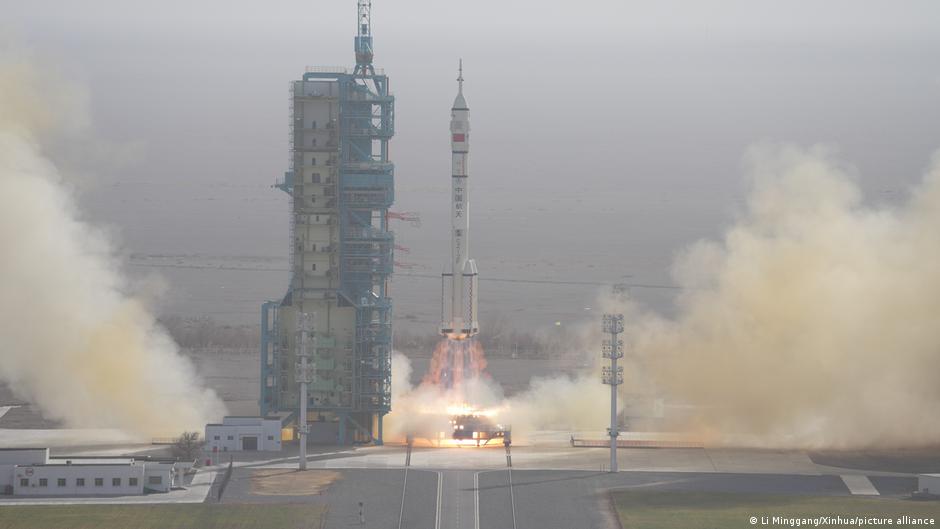
Taiwan’s President Lai Ching-te last week outlined a plan to invest an additional $40 billion (around €34.4 billion) in a special defense budget for the next eight years to develop an advanced defense system to counter China.
China, which views democratically-governed Taiwan as its own territory, has ramped up military and political pressure in recent years to assert its claims on the island.
In turn, Lai has pledged to raise Taiwan’s annual military spending to around 3.3% of gross domestic product (GDP) in 2026 — the highest since 2009 — and to reach 5% of GDP by 2030.
Highlighting the urgency of the situation, Lai pointed to Beijing’s goal of achieving “complete unification with Taiwan by force by 2027.” The remark was later modified on official platforms and clarified by the Presidential Office as referring to Beijing’s “preparations” rather than a confirmed timeline.
Despite the confusion Lai’s speech sparked in Taiwan, the United States has publicly welcomed the proposal. Washington is the island’s main security backer and arms supplier, despite not having formal diplomatic ties with Taipei.
Raymond Greene, the de facto US ambassador in Taipei, said that Washington supports Taiwan’s “rapid acquisition of critical asymmetric capabilities.”
Beijing, in turn, condemned Taiwan’s ruling party for “resisting reunification and seeking independence using armed forces” and warned this course was “doomed to fail.”
Taiwan’s budget plan — a message aimed at Washington?
Ding Shuh-Fan, an honorary professor at National Chengchi University specializing in East Asian international relations, said Taiwan’s new budget plan could be viewed as a response to US President Donald Trump’s “overall approach [and] demands regarding Taiwan.”
Taiwan has faced a growing pressure from Washington to boost its self-defense since Trump’s second term.
Lai stressed that the $40 billion defense boost is a long-planned effort to deter Chinese aggression and not linked to Taiwan-US trade talks or a recent phone call between US President Donald Trump and Chinese leader Xi Jinping. However, experts note the timing of the move is politically significant.
Taiwan is currently negotiating with the US to lower a 20% tariff on many exports and is discussing a deal that could commit Taiwan to investing more in US semiconductor capacity and sending personnel to train American workers, according to a report by the Reuters news agency.
Ahead of Lai’s announcement, China’s Xi Jinping had a phone call with Trump, during which Xi described Taiwan’s return to China as “an integral part of the post-war international order.”
Trump later said the call with Xi was “very good” but he did not mention Taiwan or echo Beijing’s language about the island.
While concerns have grown in Taiwan about whether the Trump administration might use it as leverage in dealings with Beijing, analysts say Taipei still holds the upper hand thanks to its strategic location and leading semiconductor industry.
“If President Trump were asked to ‘trade’ Taiwan to China, the question would be what China could offer in return,” Ding said.
“The bigger concern would be how to ensure US high-tech industries, including AI and semiconductors, wouldn’t be harmed by such a deal,” he added.
What is T-Dome, part of Taiwan’s new air defense system?
One of the key features of the eight year defense plan is a multilayered air defense network, known as T-Dome by the Taiwanese government. The concept was first introduced during a presidential speech at the island’s National Day ceremony in October.
The system integrates advanced sensors, AI-enabled decision‑making and interception capabilities designed to detect and neutralize threats at high speed.
“The key reason is the evolving missile threat from China,” said Su Tzu-yun, director of Defense Strategy and Resources at Taiwan’s National Defense and Security Research Institute.
Traditional ground‑launched ballistic missiles give Taiwan roughly 10 minutes of warning time, Su noted, but new sea‑based missiles from Chinese warships could reach Taiwan in as little as three minutes.
China, which has the world’s largest navy by number of warships, has continued expanding its fleet by prioritizing modern multi-role vessels like destroyers, cruisers, carriers and amphibious assault ships.
“With these new sea‑launched threats, Taiwan’s air-defense system must be more complete and react much faster,” he added.
Strengthening T-Dome, Su argued, not only enhances interception capabilities but also raises the risks for the China’s People’s Liberation Army, making Beijing less likely to embark on a military adventure.
Defense plan likely to face hurdles in parliament
President Lai’s defense proposal still needs to be approved by Taiwan’s opposition-dominated legislature.
The opposition, including the main opposition party Kuomintang (KMT), has expressed strong concerns about raising defense spending to a level equivalent to 5% of GDP.
The KMT chair Cheng Li-wun recently cautioned that “too high and unreasonable” military spending could strain Taiwan’s finances and trigger an endless arms race.
Ding told DW that Lai, knowing that the opposition would resist the budget, made a calculated move to publicly send strong signals to Washington before going through the procedure of formal parliamentary submission.
“In effect, Lai has already made his position clear to the US,” Ding said. “As for how the opposition may try to block the plan in a legislature, the ruling party can say the responsibility is not on them.”
Edited by Karl Sexton