Ask a U.S. farmer about robotics, and the response often comes with a mix of curiosity and caution. Farmers understand the premise: machines reduce labor headaches, boost efficiency, and sharpen precision, but farmers are a practical and skeptical bunch. For many, robotics remain just out of reach. Not because of a lack of interest, but because of questions about cost, usability, and return on investment.
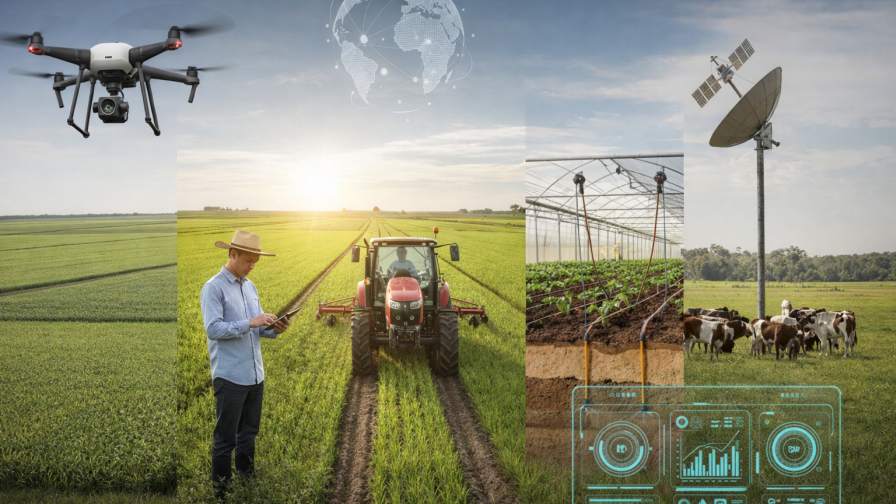
In recent years, robotics in agriculture has become an innovative space, ranging from drones that can pick apples and spot-spray weeds, to self-driving hauling and harvesting systems designed to run autonomously through the field. Start-ups such as Carbon Robotics, Agrobot, and Tevel are actively testing solutions that promise to ease labor shortages and improve precision.
Kynetec’s recent research involving a representative sample of U.S. farmers shows a clear gap between awareness and adoption. While growers recognize the potential of robotics, only a fraction use them today. So how do robotics brands, manufacturers, and start-ups, get farmers over the line from interest to sale? It requires more than engineering innovation.
Farmers and Robotics: an undeniable appeal
In Kynetec surveys, U.S. growers highlight three primary benefits to using robotics on-farm: reduced labor costs, increased efficiency, and improved precision. Labor is a pain point across nearly every sector of agriculture. Challenging conditions combined with the current administration’s immigration policies make it harder to find and keep workers. Robotics offer the promise of filling that gap. Efficiency is another motivator. During planting and harvest, time is money, and robotics could help farmers do more in less time. Integration with precision farming technologies add yet another layer of appeal, helping growers manage inputs carefully, reduce waste, and meet rising sustainability expectations.
But if the benefits are so clear, why aren’t more farmers investing in robotics? The short answer: perceived risk.
The high cost of robotics is the single biggest barrier – cited by 88% of surveyed farmers. Farmers believe these systems are expensive, though most admit they lack detailed knowledge about actual costs. This uncertainty leaves robotics in the “someday” category rather than a current priority.
Complexity and reliability are also areas of concern. Growers want tools that simplify, not complicate, daily work. Concerns about breakdowns or downtime – especially in critical windows, evenings or weekends – make them wary. Finally, return on investment is a decisive factor.
Cautious First Steps: Where Do Farmers Enter Robotics
Interestingly, robotics adoption in the U.S. tends to follow standard progression. Farmers often start with drones, which are relatively affordable, easy to deploy, and provide quick value for crop or livestock monitoring. Automated irrigation systems are a natural next step, especially in regions facing water stress. Precision sprayers attract interest because they promise direct cost savings on chemicals. This adoption pattern shows that farmers move cautiously, starting with technologies that offer immediate, visible value before considering larger, more complex systems.
Education: The Vital Link
One of the clearest findings from Kynetec’s research is that farmers consistently rate themselves as “not knowledgeable” about robotics. The problem isn’t just cost, it’s understanding. Farmers want learning opportunities they can trust. Nearly 90% prefer in-person training, and more than half (54%) say they would attend a demo or field day. These experiences provide reassurance that a product works under real-world conditions. Ease of use is another deciding factor: 95% of farmers say it’s critical to their willingness to adopt. A notable minority (15%) say they are not comfortable with technology at all.
With all of this in mind, how do robotics brands and start-ups motivate farmers to engage with a robotics sales pipeline? The message is straightforward: education, hands-on exposure, and simplicity are just as important as the technology itself.
To generate leads, robotics brands should attend agricultural shows, field days, farm walks and other such farming community events. This allows brands to meet farmers off farm while they have some time to concentrate on new offers. Robotics brands can use this time to demonstrate value directly, and answer questions face-to-face. This not only helps to educate farmers about how automation can solve real on-farm challenges and integrate with existing digital farming technology. This builds credibility and relationships that digital marketing alone cannot achieve.
For warm leads, robotics brands should adopt a ‘boots on the ground’ approach, going down the farm drive, and visiting farmers in person to show the technology in action. This requires a particular type of salesperson; one who speaks ‘farmer’ as well as tech and can understand practical implications of both arable and livestock operations.
Value Add: Where Should Robotics Brands Target?
Farmers point to precision spraying (63%), weeding (46%), and crop monitoring (36%) as the areas with the greatest potential. The reasoning is practical – crop protection is expensive, and robotics that improve spray targeting offer clear savings, as well as sustainability improvements. Digital crop monitoring can help farmers spot stress or pests early, reprioritize their time, and protect crops before problems escalate.
These tasks are first to mind for farmers as they are of high importance, practical tasks – a natural first step in farm decision-making.
Subsidies and incentives also influence decisions, with one in five farmers saying they would be more likely to try robotics if financial support were available.
Infrastructure: Crucial Yet Often Missing
Adoption is also limited by infrastructure, specifically Wi-Fi and power connections away from the main farmyard. Nearly half of farmers surveyed are unsure if their operations have the connectivity or compatibility to support robotics. Remote, outdoor locations are often not compatible with sensitive tech.
For robotics brands, this means solutions must be designed for accessibility and scalability. Supporting farmers’ wider requirements around infrastructure, even if that means collaboration between robotics brands and infrastructure companies. For the tech itself, simple interfaces, intuitive controls, and reliable service networks are essential – and need to be weather-proof and stock-proof.
Positive Outlook, Despite the Challenge
Despite today’s barriers, the outlook is positive. Drones and irrigation systems are already gaining traction, and 52% of surveyed farmers believe robotics will become commonplace within the next 5-10 years.
However, it’s important to acknowledge recent developments in the industry that are shaping the current conversation. Most notably, the shutdown of Guardian Agriculture, one of the pioneering drone start-ups in the US. Its closure has prompted many in the sector to reflect on what success in agricultural robotics truly requires.
But what should robotics brands focus on, to access this market? The research tells us the top five are:
- Demonstrate usability through field days and hands-on demos
- Design for accessibility across diverse farm sizes and infrastructure levels
- Build trust through long-term service and support
- Focus on priority tasks such as spraying, weeding, and monitoring
- Educate clearly on cost and ROI to counter misconceptions
That said, the Guardian Ag story reminds us that even when a robotics company does many of these things – attending field days, building farmer relationships, showcasing ROI – success is not guaranteed. The real learning may lie in understanding the demographic of the farming audience and what that means for engaging with technology. The US farming population is aging, with a rising average age of 58, and a growing proportion of older producers. Not that age precludes interest or ability in new technology, but it does suggest a requirement for additional learning, having not grown up online. In 2022, 14% of the US farm operators were aged 75+, with just 13% aged 35-44.
Robotics adoption is not about chasing innovation, it’s about solving problems efficiently, so farmers can get on with other tasks that require their physical input.
Kynetec’s research makes it clear: adoption depends on education, usability, and ROI. Manufacturers that step into the grower’s perspective by delivering tools that are practical, profitable, and easy to integrate, will be the ones who turn robotics from promising concepts into an ‘extra pair of hands’ on the farm.
Want to find out more about Kynetec’s US robotics study? Contact Cody Roewe at [email protected] or read more here.